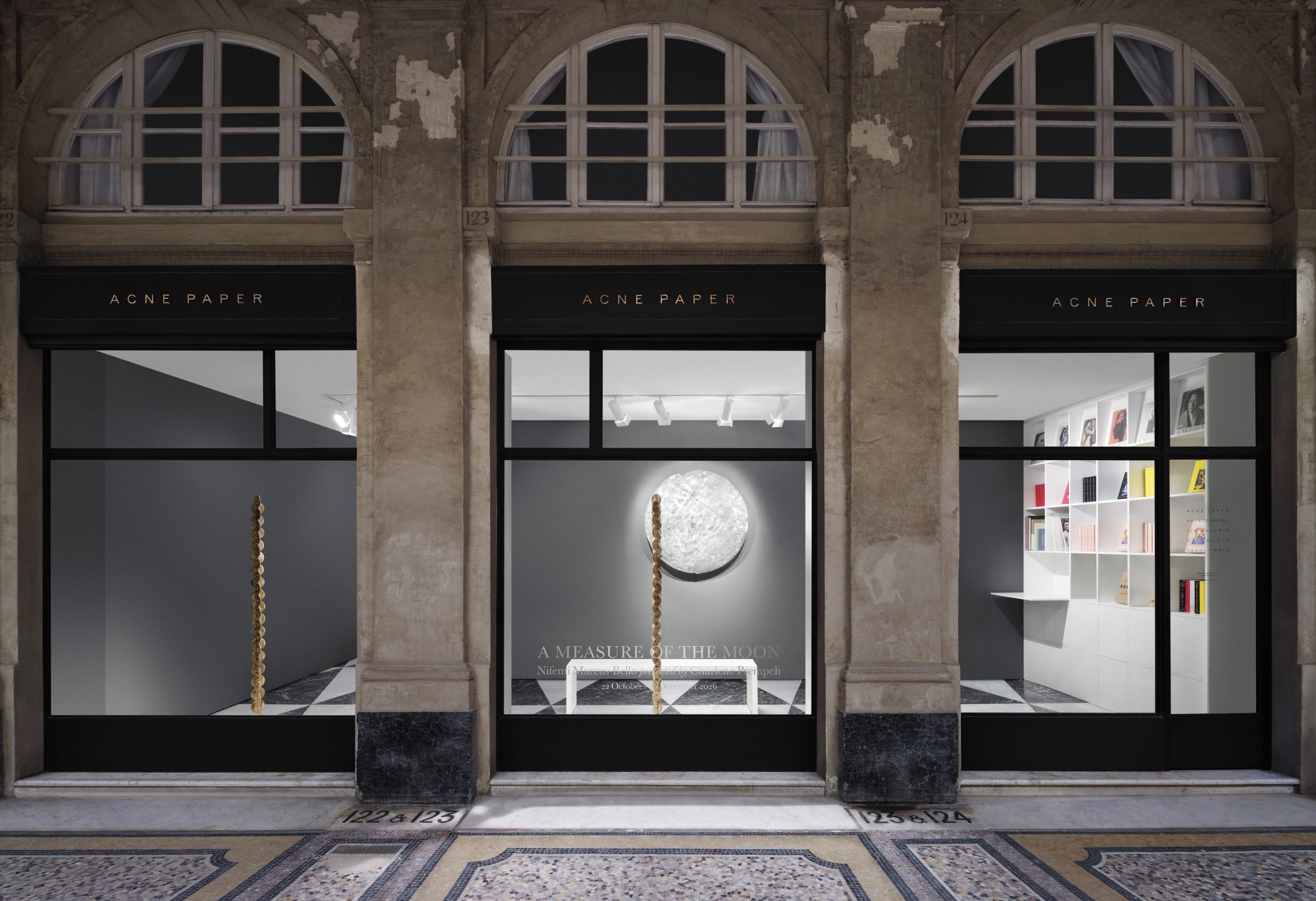
The matter retains the memory of time, tells the transformations of society, and reveals the economic and cultural dynamics that permeate the contemporary world. It is from this perspective that A Measure of the Moon is born, the exhibition by Nifemi Marcus-Bello presented by Charlene Prempeh for Acne Paper at the Palais Royal, from October 22 to December 20, 2026. Artist and designer based in Lagos, Marcus-Bello develops a research that intertwines design, craftsmanship, and social reflection, investigating how materials narrate cultural identities and production systems. In this new exhibition, his focus is on the resources of Nigeria, their circulation, and the consequences that global consumption has on the manufacturing economies of the Global South. 
Matter as cultural memory
The project continues the path started with the sculptural series Material Affirmations: Oríkì Acts I–III, in which the artist explored the relationship between identity and materials emblematic of Nigerian culture.  With A Measure of the Moon, this research expands, transforming bronze and aluminum into tools of historical and cultural investigation. Objects are no longer just functional elements or aesthetic forms, but testimonies of production processes, craft traditions, and economic relationships.
 At the center of the reflection emerges a current issue: excessive resource consumption in Global North countries can compromise the availability of materials and the economic sustainability of manufacturing activities in Global South territories. Through design, Marcus-Bello draws attention to the often invisible systems that determine how resources are extracted, transformed, used, and distributed.

Bronze and aluminum: stories of transformation
In the exhibition, simple discs become tools to explore the historical and cultural significance of bronze in West Africa. Essential forms that invite observation of a material deeply linked to the artistic and manufacturing history of the region.  An equally important role is given to aluminum, the protagonist of a research inspired by Tales By Moonlight, Act II of the Oríkì series. In Lagos, this metal is recovered, melted, and remelted in informal foundries, entering into a continuous cycle of reuse.
 Marcus-Bello translates this dynamic into forms that evoke the moon and the container, bringing visibility to a productive culture based on ingenuity and the ability to transform available resources.
 Sand casting, one of the most common and sustainable metalworking processes in Nigeria, is instead evoked through form, becoming a representation of time. A choice that suggests the untapped potential of the Nigerian manufacturing industry, but also the contradictions related to the exploitation of the country’s resources.
The moon as a measure of time
The title of the exhibition introduces a symbolic dimension that runs through the entire project. In various African societies, the observation of the sun, moon phases, and constellations has traditionally helped to mark time, accompanying agricultural activities, ceremonies, meetings, and moments of collective life. In this context, the moon becomes a tool for measuring change and reflecting on the continuity between past, present, and future. Time is not conceived as a straight line, but as a cyclical process in which each transformation can generate new possibilities. Materials are recovered and reintroduced into production processes, craft techniques are rediscovered and reinterpreted, while what seems limited can become a resource for new forms of creativity.  The moon thus assumes a dual function: it is a provocation because it invites reflection on resource consumption and exploitation, but also a reassuring presence, a symbol of continuity and regeneration.
The sound of oríkì, a voice that runs through the exhibition
Giving rhythm to the exhibition path is the sound landscape of oríkì, a Yoruba practice of poetry and identity affirmation. On this occasion, the voice is that of Folake, the artist’s mother, who contributes to connecting the personal dimension to the collective one.  The sound component is not just an accompaniment but an integral part of the exhibition structure. The transmitted word, family memory, and cultural identity enter into dialogue with forms and materials, expanding the visitor’s experience. It is a way to emphasize that a community’s heritage resides not only in objects but also in voices, gestures, and knowledge passed down through generations.
Nifemi Marcus-Bello, between design and social research
Based in Lagos, Nifemi Marcus-Bello develops a practice that moves between product design, furniture, installations, and research projects. His work investigates the social, cultural, and economic systems that influence everyday life, relating the observation of materials to the ways in which they are produced and consumed. Collaboration with local artisans and industrial realities is a central element of his method. Through experimentation, the artist explores new possibilities for the use of materials often considered common, transforming them into objects and forms capable of telling broader stories. His work is present in the collections of international institutions such as the Museum of Modern Art in New York, the Brooklyn Museum, the Los Angeles County Museum of Art, the Art Institute of Chicago, and the Design Museum in London. Among the recognitions received are a special mention at the Loewe Craft Prize, the Hublot Design Prize, and the Monocle Emerging Designer Award. In 2026, he was also selected as a finalist for the Wallpaper* Designer of the Year Award.
Charlene Prempeh and the dialogue between art and contemporary culture
The exhibition is presented by Charlene Prempeh, founder of A Vibe Called Tech, a creative studio and artistic consulting company based in London. A journalist and curator, Prempeh deals with design, art, travel, and culture, promoting projects that expand the representation of black identities and experiences in the contemporary creative landscape. Her path includes collaborations with institutions such as Whitechapel Gallery, White Cube, Royal Academy, and V&A East, as well as roles in the international museum and art sector. In 2023, she published the book Now You See Me: An Introduction to 100 Years of Black Design, dedicated to a century of black design. Her presence in A Measure of the Moon strengthens the dialogue between artistic research, material culture, and contemporary narratives, offering a perspective that relates local experience to global dynamics.
A new way of looking at resources
A Measure of the Moon invites us to rethink the value of objects and materials that accompany everyday life. Each element carries a story of work, knowledge, exchanges, and transformations, often invisible once the product reaches the consumer. Marcus-Bello’s research suggests that the future of manufacturing may also arise from the rediscovery of existing skills, the recovery of resources, and a greater awareness of production processes.
As the artist states, “objects hold traces of what preceded them, suggest what could come after, and express what is happening in the present.”
A vision in which design surpasses the purely aesthetic dimension and becomes a tool to question the present, preserve cultural memory, and imagine new possibilities for regeneration.