Andrea Maffei, founder of Velvet For Philosophers and Unsane Practice, discusses the research behind the Milanese project: between archive fashion, second-hand and new collections, a reflection on what truly makes a garment special.
The value of a garment is not measured solely by its label, rarity or the price it can command on the market. It is from this conviction that Iconico took shape, the project that returned to Milan from 28 October to 1 November, at Moscova District Market, bringing New Fashion, Second-Hand and Archive Fashion into dialogue. A journey that goes beyond the traditional categories of the market to bring together major maisons, second-hand luxury and archival research. We spoke to Andrea Maffei to explore the meaning of the selection, the transformations of second-hand and the relationship between fashion, culture and identity.

«If everything returns to circulation, nothing has any value»: what does this statement mean?
We need to distinguish between two aspects: the material one, linked to textile recovery, and the aesthetic one, linked to the concept of modernity. In the European textile recovery system, only an infinitesimal proportion of the garments collected can be considered genuinely vintage. We are talking about pieces that, in terms of the quality of their materials, construction and manufacture, represent a past that is still capable of saying something.
There is also an aesthetic question: not everything that belongs to the past retains its relevance. Certain proportions, constructions and stylistic solutions manage to cross different eras without losing their expressive power. I am thinking of Eighties tailoring, certain deconstructed coats or denim from the late Eighties and early Nineties. Recovering everything indiscriminately would mean giving up any idea of taste. The value of a garment depends on its quality, history and, above all, its ability to continue expressing something in the present.
Second-hand has become a global market. How can the authentic value of a garment be distinguished from its commercial desirability?
First of all, we need to distinguish between different audiences. There is an archival universe linked to designers such as Yohji Yamamoto, Comme des Garçons, Ann Demeulemeester, Martin Margiela and Raf Simons, whose creations represent significant moments in fashion history. Then there is an audience that recognises the value of manufacturing quality, for example in old leather jackets, denim and Italian tailoring from the Eighties.
The market, however, is far more heterogeneous. Global growth has been driven above all by digital platforms, which have turned millions of private individuals into sellers and buyers. The authentic value of a garment may have a historical-linguistic origin or a material and manufacturing one. Commercial desirability is something else: it depends on trends and on the market’s ability to generate interest around an object. The two dimensions may coincide, but not necessarily.
If we removed a garment’s brand name and production date, what would need to remain for it to be interesting?
I think of Comme des Garçons: its most important lines could easily be without a label and remain recognisable. Rei Kawakubo has created a personal sensibility and language that run through forms, proportions, fabrics and constructions. The same applies to Yohji Yamamoto and Rick Owens.
With Iconico, we are specifically trying to bring these universes together. On one side, Japanese research, with its often abstract and conceptual approach; on the other, the bourgeois language of the major European maisons, from Louis Vuitton to Gucci and Burberry, linked to shared aesthetic and social codes. We are interested in having the garments, their constructions and their languages engage with one another, before the labels they carry.
What is the difference between a current garment and a modern one? And how do you recognise what deserves to enter your archive?
Relevance is ephemeral: it can be extremely strong today and lose significance tomorrow. Modernity, on the other hand, remains active over time. One example is Ralph Lauren, a brand to which we are particularly attached and to which we have dedicated an important part of our archive.
Its strength goes beyond commercial fluctuations. It has created a complex iconographic universe, capable of bringing together the ranches of Texas, New England, travel culture and New York’s bourgeoisie. Even apparently simple elements, such as Oxford cottons, shirt constructions, stripes and the colour blocking of the Nineties, retain great modernity.
We continue to acquire and expand our Ralph Lauren archive even beyond periods of greater commercial exposure. We do not simply want to collect garments, but to construct a coherent account of an imaginary world. This is the difference between chasing what is current and recognising what remains modern.
Clothes, accessories and books are also tools through which we tell the story of our identity. What does our relationship with objects reveal today?
Clothes, accessories, books and records are above all languages. They are tools through which we allow others to approach our inner selves, recognise our identity and our vision of the world.
I think of underground music and the way it influenced designers such as Jean Paul Gaultier and Raf Simons: clubbing culture and the communities that animated it became aesthetic references translated into clothing. Fashion arose from a need for individual and collective representation.
Today we are witnessing a progressive impoverishment of these languages. Globalisation, the dominance of technology and fast fashion have contributed to an increasingly evident aesthetic homogenisation. But the problem is deeper: languages begin to die when inner lives wither. If fashion seems to have fewer voices and less ability to produce new countercultures, perhaps it is because individuals and communities also have fewer personal visions to express.
After last year’s first event, Iconico returns to Milan. How has the project evolved and where would you like to take it?
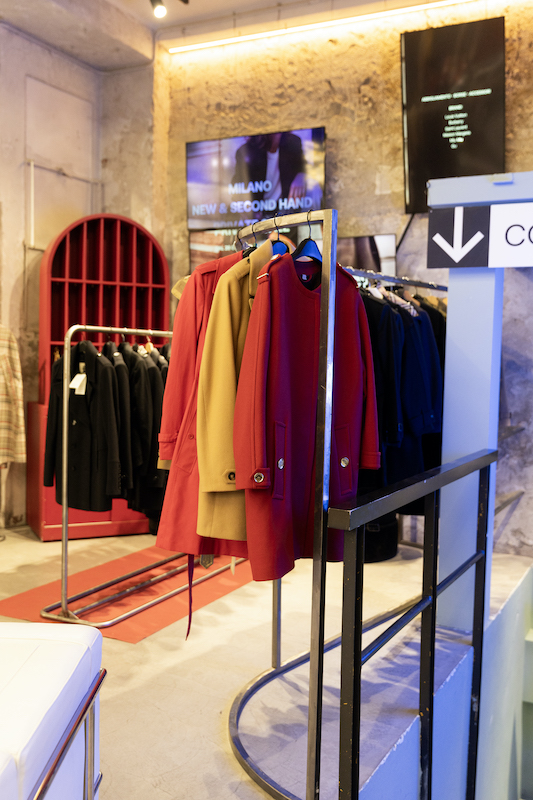
The space has changed first and foremost. Last year we were guests of My Closet, whereas today we are at Moscova District Market, a setting that allows us to develop the different languages of fashion with greater freedom: the bourgeois language of the major European maisons, the conceptual and archival language, and Ralph Lauren’s American imaginary.
The project continues to evolve alongside a fashion system undergoing profound transformation. One of the directions I would find most interesting would be to bring the archival dimension of a maison and that of its contemporary collections together in the same space, also through private sale formats. I imagine, for example, an archival selection from Maison Margiela alongside its most recent collections, to show how the original intuitions have been reinterpreted over time.
I would like Iconico to become a space capable of showing not only the clothes, but also the continuity, transformations and contradictions of fashion languages. Not an indiscriminate sale, but a recognisable aesthetic and cultural construction, in which every element contributes to a broader narrative.
Iconico’s calendar continues
After Milan, the project continues its journey through other Italian cities. Iconico’s next events are scheduled in Modena, from 12 to 15 November, in Porto Sant’Elpidio, from 19 to 22 November, and in Parma, from 10 to 13 December. A calendar that confirms Unsane Practice’s intention to develop the format beyond a single event, bringing its research into contemporary fashion, second-hand and archives to new settings.